
Overview
Tattoos have been storytellers for thousands of years, symbolizing courage, rebellion, belonging, and beauty. They carry personal histories and traditions, from ancient tribal markings to modern designs. Each tattoo represents a chapter in someone's life, yet they remain unchanged in a dynamic world.
Their cultural presence is undeniable, with 7% of Millennials and 36% of Gen X’ers sporting at least one tattoo. These figures highlight growing acceptance of body art a form of identity and self-expression across generations.


But in a lab filled with sketches, biosensor prototypes, and speculative design frameworks, our team asked:
“What if tattoos could talk back?”
The Problem – Static Ink in a Dynamic World
Tattoos have always been deeply personal, but their nature has been unchanging for centuries. Once ink is etched into skin, it stays the same — regardless of how your body, environment, or emotions change over time.
In an age where wearable devices constantly track our steps, heart rate, sleep cycles, and even stress levels, body art remains purely aesthetic — disconnected from the dynamic data of our lives.
We identified three key gaps:
01
No Interactivity
Traditional tattoos cannot respond to internal health signals or external environmental changes.
02
Bulky Alternatives
The wearable health tech market is dominated by watches, straps, and patches that feel medical rather than personal.
03
Aesthetic-Utility Divide
Devices that track health rarely serve as self-expression, forcing users to choose between beauty and function.
The Spark
Tattoos have always been deeply personal, but their nature has been unchanging for centuries. Once ink is etched into skin, it stays the same — regardless of how your body, environment, or emotions change over time.
Picture this:
A sunny afternoon.
A forearm inked with a delicate pattern.
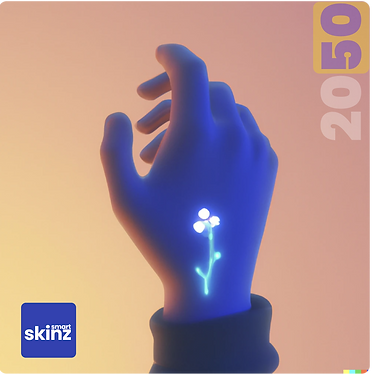
Under the sun’s rays, the tattoo slowly shifts to blue, warning of harmful UV levels.
In the shade, it fades back — a silent, beautiful protector.
That vision became our north star.
Exploring the Evidence

Solar Freckles
Dermally implanted colorimetric UV sensors in the form of nano encapsulated leuco dyes that become more blue in color with increasing UV irradiance.
The color of the ink disappears upon removal of UV exposure or on application of topical sunscreen. (Butterfield’2020)
Wearable Biosensors
Real time physiological information via dynamic, noninvasive measurement of biochemical markers in biofluids, such as sweat, tear, saliva, and interstitial fluids.
E-Tattoo
Soft, sensor-equipped wearable devices that attach to a person’s skin and are typically used to gather data.
A self-contained device that measures vital signs related to a chronic health condition and automatically releases medication as needed.

Optical Biosensing
Replacement of tattoo pigments with optical biosensors aims a promising alternative for monitoring blood biomarkers.
Real-time sensing with long-term permanence for the control, diagnosis, and prevention of illness.
Enables self-controlling management by the patient, but also the possibility of sending the records to the doctor.
(D.Pazos’2021)
Speculative Design Approach
Speculative design is a design approach that explores possible futures and alternative realities through creative and imaginative thinking
1. Things of Future

2. Driver Mapping

3. Axis of Uncertainty

4. Future Cone

1. Things of Future
How did we conduct it?
A - ARC - Defines an era
T - TERRAIN - Defines the domain
O - Object - Defines the object
M - Mood - Defines the emotion
We curated this exercise among our team and with our friends to get an understanding of how this exercise/game works.
Because of our findings from secondary research we were able to freeze two elements of ATOM, Arc & Terrain because, we wanted the subject group to focus on the future of tattoos in 2050 and limit their ideas with it.

2. Driver Mapping
To derive these drivers we used a methodology called PESTLE analysis.
It studies the key external factors (Political, Economic, Sociological, Technological, Legal and Environmental) that influence an organization in future.


3. Axis of uncertainty
Represented as a two-dimensional graph, with one axis representing the degree of certainty or predictability of the future outcomes of the design intervention, and the other axis representing the degree of desirability or acceptability of those outcomes
Goals of this method
The goal of the axis of uncertainty is to help designers identify the potential risks and benefits of a particular design intervention and to navigate the complex and uncertain landscape of potential outcomes.

4. The Cone of Future
The “cone of future” is a conceptual model used to represent the range of possible futures that may emerge based on current trends and actions. It is depicted as a cone-shaped diagram that illustrates the narrowing range of possibilities as we move further into the future.
Preposterous: Impossible
Possible : Might Happen
Plausible : Could Happen
Projected : Default
Probable : Likely To Happen
Preferable : Desirable
Future Explorations
Projected
Business as casual
The global tattoo market size was valued at USD 1.9 billion in 2018 and is projected to reach USD 3.3 billion by 2026.
Possible
Might Happen
As with any advancing technology, there will be certain constraints to consider, such as precision, longevity, and safety over extended periods of time.
The technology is still is in lab research phase.
Plausible
Could happen
Negative: non sanitized tattoos can lead to health hazards by using fake inks, contaminated needles, etc. forming the govt. to put restrictions on the use of smart tattoos
Preposterous
Impossible
It is improbable that tattoos will be completely eliminated as a means of self-expression.
Universal acceptance of tattoos regardless of cultural or religious differences.
Preferred
Our Vision(Should Happen)
Bio-sensors could be used to create “smart tattoos” that can monitor various health parameters and communicate them to the wearer or healthcare.
Soft wearable device with integrated sensors that attaches to the wearer’s skin and transmits data wirelessly.
Probable
Likely to happen
While the popularity of UV-based tattoos is increasing through social media exposure, the cost of this technology remains relatively high.
Our Concept
Skin based monitoring tattoo
Soft wearable device with integrated sensors that attaches to the wearer’s skin and transmits data transdermally.
The exterior surface of the body provides a platform to obtain information about the inner, biological functions.
Target user : 1. Diabetic patients 2. People concerned with sun exposure and hydration levels
Bio-sensing Nanotech tattoo Ink
Bio sensing inks that can detect and measure different physiological parameters.
Hydration Levels
Sun Exposure Levels
Glucose Levels
Development of a tattoo ink that changes color in response to variations in glucose levels.
The ink contained an enzyme that reacts with glucose and produces a color change which acts as a visual reminder.
Current tech validation
Triboelectric Nano generators
Enabled by epidermal electronic technology
Epidermal Electronics to harvest energy. Convert mechanical energy into electrical from daily body motions. Ultrathin, soft and tattoo like appearance. Well structured design can be customized in to various designs
Wearable biosensors
Healthcare monitoring
Real-time physiological monitoring via biochemical markers
Integrated multiplexed biosensing and microfluidic sampling
Flexible materials for improved wearability
Accurate and reliable real-time sensing
Easy operation
Hybrid nano-gel based
Printable tattoos for monitoring solar UV radiation
Printable Tattoos
Hybrid Nano-gel
Monitor UV radiation from sunshine
Dyed hybrid nanogel color correlates with solar radiation dose.
Real-time color check for monitoring UV radiation from sunlight.
Solar Freckles
Long-term photochromic tattoos for intradermal UV Radiometry
Photochromic tattoo as UV radiometer.
Real-time naked-eye UV exposure feedback.
Dermal implants: Nano encapsulated leuco dye sensors.
Increasing blue color indicates higher UV.
Visual reminder for skin protection.
Long-lasting sensors, lasting months or years.

SWOT Analysis

Conclusion
In conclusion, the development of tattoo biosensing ink and nanotechnology has shown immense potential in revolutionizing the way we monitor and track our health.
With the ability to detect a wide range of health parameters in real-time, these technologies have the potential to enhance medical diagnosis and treatment, as well as improve overall health and well-being.
However, there are still significant challenges that need to be addressed, including concerns around the safety, efficiency, and ethical implications of these technologies.
Nevertheless, with ongoing research and development, tattoo biosensing ink and nanotech hold great promise for the future of healthcare.

Glucose Monitor Patch

SmartSkinz Patch

